Mastering
Mastering for streaming, vinyl and CD
Mastering is the last check before your music goes out: fresh ears on your mix, a consistent sound across every track and files that meet the requirements of each format.
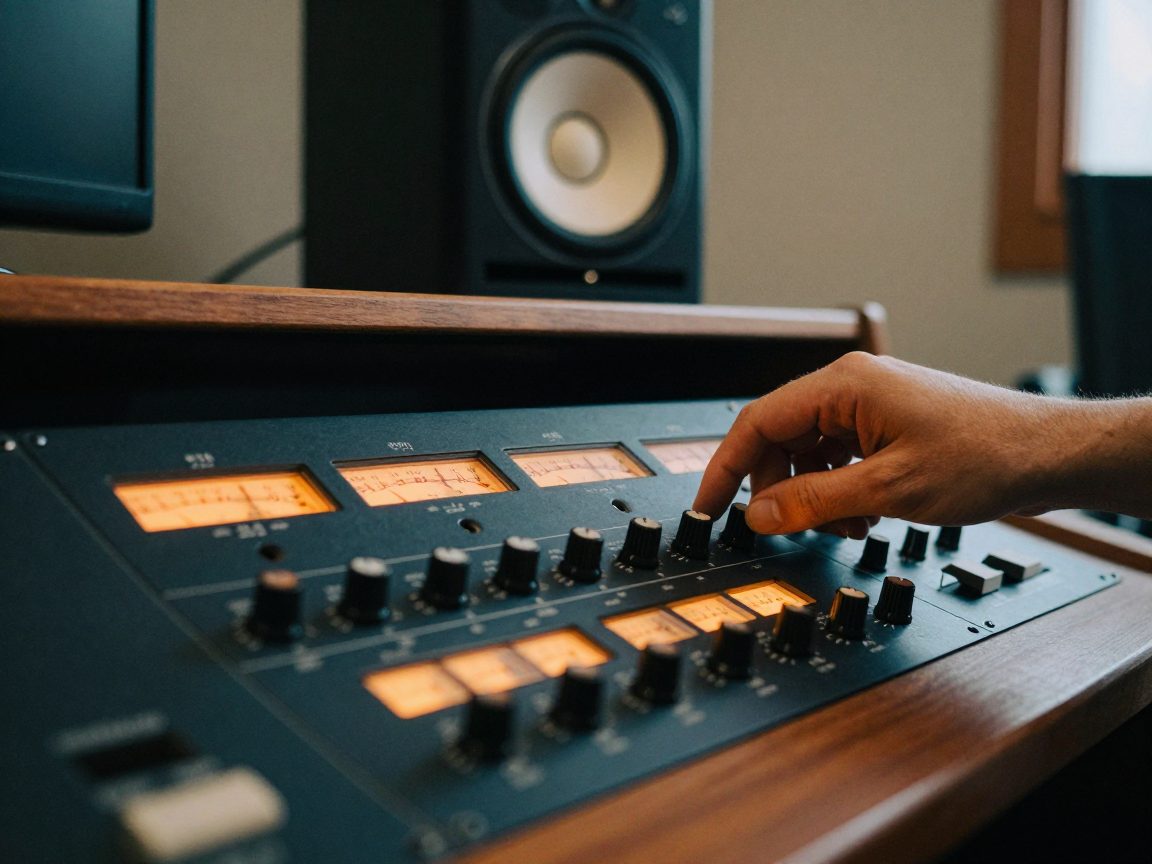
After weeks on a mix you can no longer hear it with an open mind. A mastering engineer listens with new ears, in a room where lows and highs translate reliably, and makes small but decisive corrections: a little less edge on the vocal, a tighter low end, a stereo image that opens up slightly. At Vedrodev this work is done by Femke Bakker, with her attention on the whole picture rather than on individual tracks.
Mastering is gentler than many people expect. We cannot rescue a poor mix, but we can bring a good one in line with what listeners are used to on streaming platforms, radio or vinyl. On an EP or album we also make sure the songs belong together in level and tonal colour, so nobody has to reach for the volume knob by track three.
How it works
Send your mix
Send the final stereo mix as a WAV at its original sample rate, with no limiter on the master bus and some headroom. Tell us the release format: streaming, vinyl, CD or a combination.
Listen and analyse
We play the mix through and compare it with your references. We measure loudness, peak level and frequency balance and note what can improve.
Process and compare
EQ, compression and limiting in small steps, always compared at matched volume with the original mix so louder never passes for better.
Masters per format
You receive a master for each chosen format, with the right file types, metadata and gaps between tracks. After that you have 2 revision rounds.
When to get your music mastered
Book mastering once the mix is finished and you are happy with balance and arrangement. It is the right step for:
- a single you are releasing to streaming platforms through a distributor;
- an EP or album whose songs were mixed in different sessions or even different studios;
- a vinyl pressing, where low end, sibilance and side length all have technical limits;
- a CD release, where the pressing plant needs a ready-made image;
- music for film, games or advertising that has to sit alongside other material.
Not sure your mix is ready? Send it over and we will tell you honestly whether a change in the mix would gain more than mastering. Mixing is available here too, see mixing.
Loudness: how loud is loud enough?
Streaming platforms normalise playback volume: a track mastered very loud simply gets turned down, so the benefit of extra loudness disappears while the lost dynamics stay lost. That is why we master to a level that suits the genre and dynamics of your music, not to the highest number achievable.
| Format | Integrated loudness | True peak |
|---|---|---|
| Streaming | around −14 to −9 LUFS, depending on genre | −1 dBTP maximum |
| CD | set for the album as a whole | −0.3 dBTP maximum |
| Vinyl | more dynamics, less limiting | depends on the cutting engineer |
These are starting points, not fixed rules. Our guide on loudness in mastering explains what the readings mean and why a heavy rock song and a piano ballad are handled differently.
What happens during mastering
The work comes down to a handful of processes, each applied with care:
- Corrective EQ
- A bloated low-mid or a harsh vocal is nudged by a fraction.
- Dynamics
- Gentle bus compression to glue the mix, sometimes per frequency band.
- Stereo image
- We keep the low end centred and let the top end open up a little.
- Limiting
- The final stage that controls peak level and reaches the agreed volume.
- Noise shaping and dither
- When converting to 16 bit for CD, we add dither to avoid distortion.
Every step is compared at matched volume with the untreated mix. If a move only sounds better because it is louder, we leave it out.
Albums: running order, transitions and cohesion
On an album, mastering is also an editorial job. Together we settle the final running order, the gaps between songs and any crossfades or tracks that flow into each other without silence. We make sure a quiet acoustic number next to a full band track does not suddenly drop away, and that the record plays as one story from start to finish.
For an album, send a list of titles, running order and, if you have them, the ISRC codes from your distributor or label. We embed them in the metadata of the CD image and the files.
What you receive
- Streaming master: WAV, 24 bit, at your mix's sample rate, accepted by all common distributors.
- CD master: a DDP image at 16 bit / 44.1 kHz with running order, gaps and metadata, plus a check file for the pressing plant.
- Vinyl master: separate files per side, with processing adapted for low end and sibilance.
- Reference: an MP3 for quick sharing with your band, label or publicist.
Masters are ready within 7 working days of receiving your complete mix. We keep the mastering session for 6 months, so a later version, say a vinyl master after a digital release, can build on the same settings.
Revisions and the limits of mastering
After the first master you have 2 revision rounds: a touch more or less level, more clarity, or a different gap between two songs. If the mix itself needs changing, for example because the vocal sits too low, your mix engineer supplies a new version and we master that again. In mastering we only have the stereo mix, not individual tracks, so turning up one instrument on its own is not possible.
If your mix can be split into stems, such as vocals, beat and instruments in three groups, we can discuss stem mastering. It gives more control, but it also takes more time.
Price per track or per album
Mastering a single track costs €70. An album of up to twelve tracks is €540, including running order, gaps and a streaming master. Prices include 21% Dutch VAT; excluding VAT that is €57.85 per track and €446.28 per album.
Extra format versions, such as a separate vinyl master next to the streaming one, or stem mastering are agreed with you beforehand. Not included are mixing, applying for ISRC or EAN codes and the fees of a pressing plant or distributor.
We start after a 30% deposit. All arrangements on payment, delivery and use are in the terms and conditions. Questions about your project? Get in touch through the contact page.
What you get
- Listening session and analysis of loudness, peaks and frequency balance
- Mastering in an acoustically treated room
- Matched-volume comparison with the untreated mix
- Streaming master as WAV at your mix's sample rate
- Running order, gaps and metadata for albums
- Revision rounds on the master as set out in the terms
- Session archived for later format versions
Frequently asked questions
How much headroom should my mix have?
Let the loudest peaks land around −6 to −3 dBFS and keep the limiter off the master bus. If you want to include your own loud version as a reference, that helps us understand your taste.
Can I attend the mastering session?
Yes, by appointment within our opening hours. You can also work remotely and judge the master on your own speakers.
Is a five-track EP charged as an album?
For five tracks the album rate is usually more than five single masters. We charge whichever works out cheaper for you and tell you in advance.
Do you deliver for Apple Digital Masters?
We deliver high-resolution WAV files suitable as a source. Whether your release carries that badge is up to your distributor or label, not us.
How quickly do you reply to a request?
Within 2 working days. Send a link to your mixes to [email protected] or call 020 846 3172 during opening hours.
More services
- Vocal and instrument recordingRecording vocals or a single instrument in our isolated booth, engineer included.€85per hour
- Live band recordingTracking your whole band at once in the live room, every instrument on its own track.€420per half day (4 hours)
- Podcast recordingRecording conversations with up to four speakers, basic edit included.€145per episode (up to 90 minutes)
- Voice-over and voice workVoice recordings for ads, e-learning and video, directed in the room or remotely.€110per hour
- MixingYour recorded tracks balanced into a finished stereo mix.€290per track
Recording in Amsterdam soon?
Tell us what you want to capture
Send a short description and a few possible dates. Within 2 working days you get a proposed slot and a written quote.